mirror of
https://github.com/apache/zeppelin
synced 2026-05-24 09:38:26 +00:00
 86bc9332e0
### What is this PR for? Updated `interpreter_binding_mode.md` since users are sometimes confused what this mode means and there is already opened JIRA issue. This documentation will be helpful to Zeppelin users. **disclaimer: content was copied from [here](https://medium.com/leemoonsoo/apache-zeppelin-interpreter-mode-explained-bae0525d0555) with author's consent.** ### What type of PR is it? [Documentation] ### Todos DONE ### What is the Jira issue? [ZEPPELIN-2582](https://issues.apache.org/jira/browse/ZEPPELIN-2582) ### How should this be tested? 1. setup rvm 2.1.0+ and install required bundles for `docs/` 2. bundle exec jekyll serve --watch 3. http://localhost:4000/usage/interpreter/interpreter_binding_mode.html ### Screenshots (if appropriate) 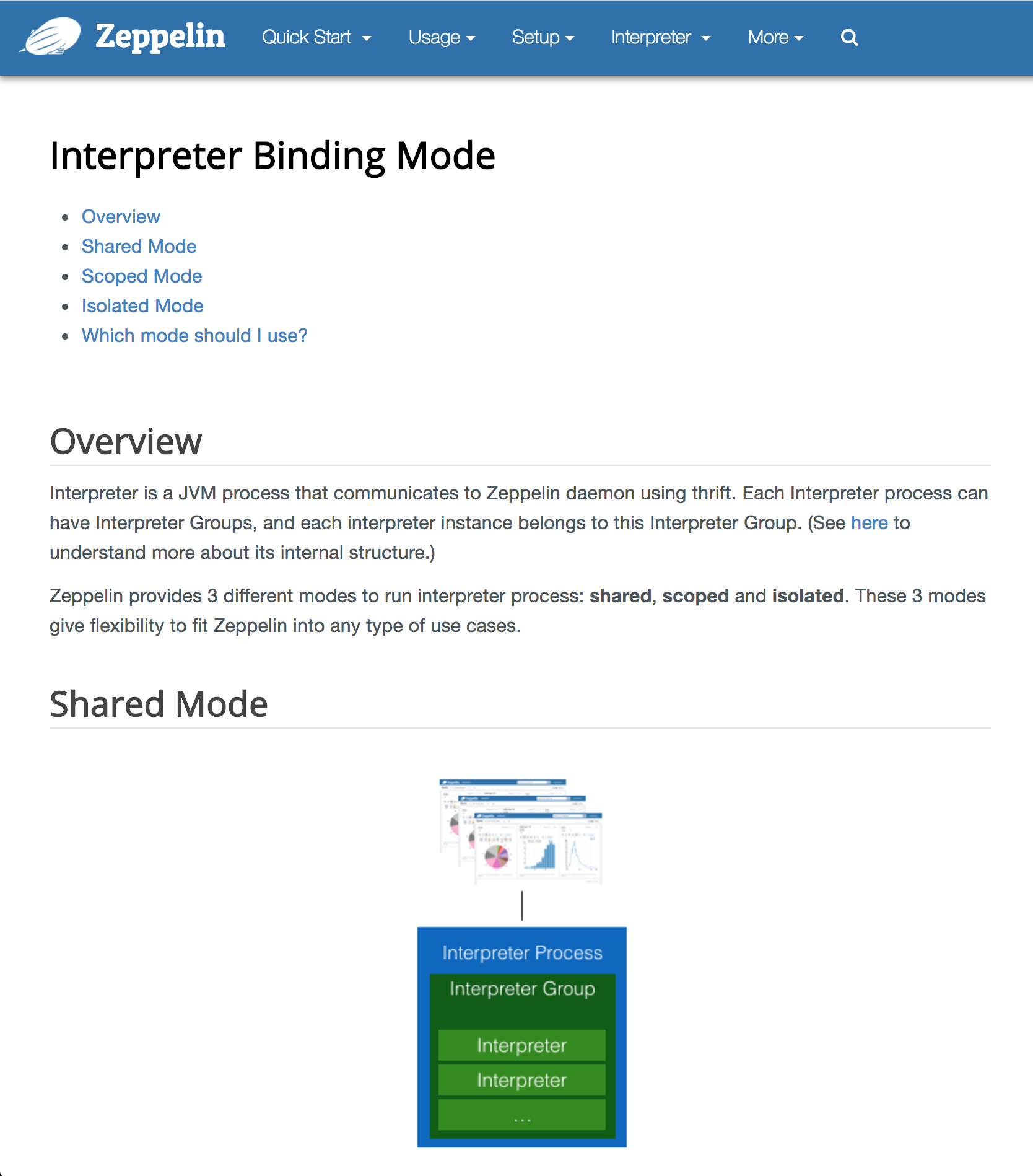   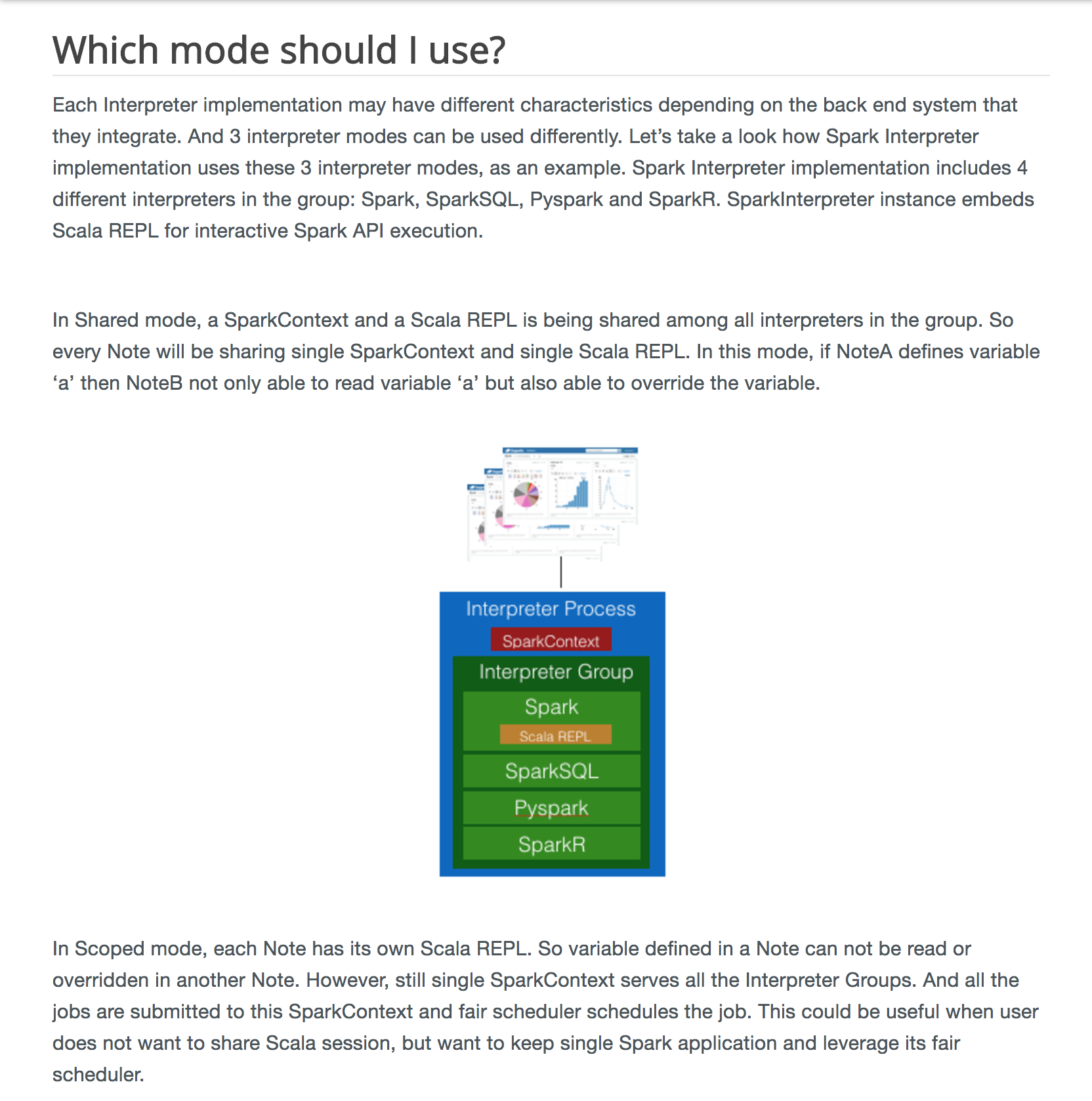 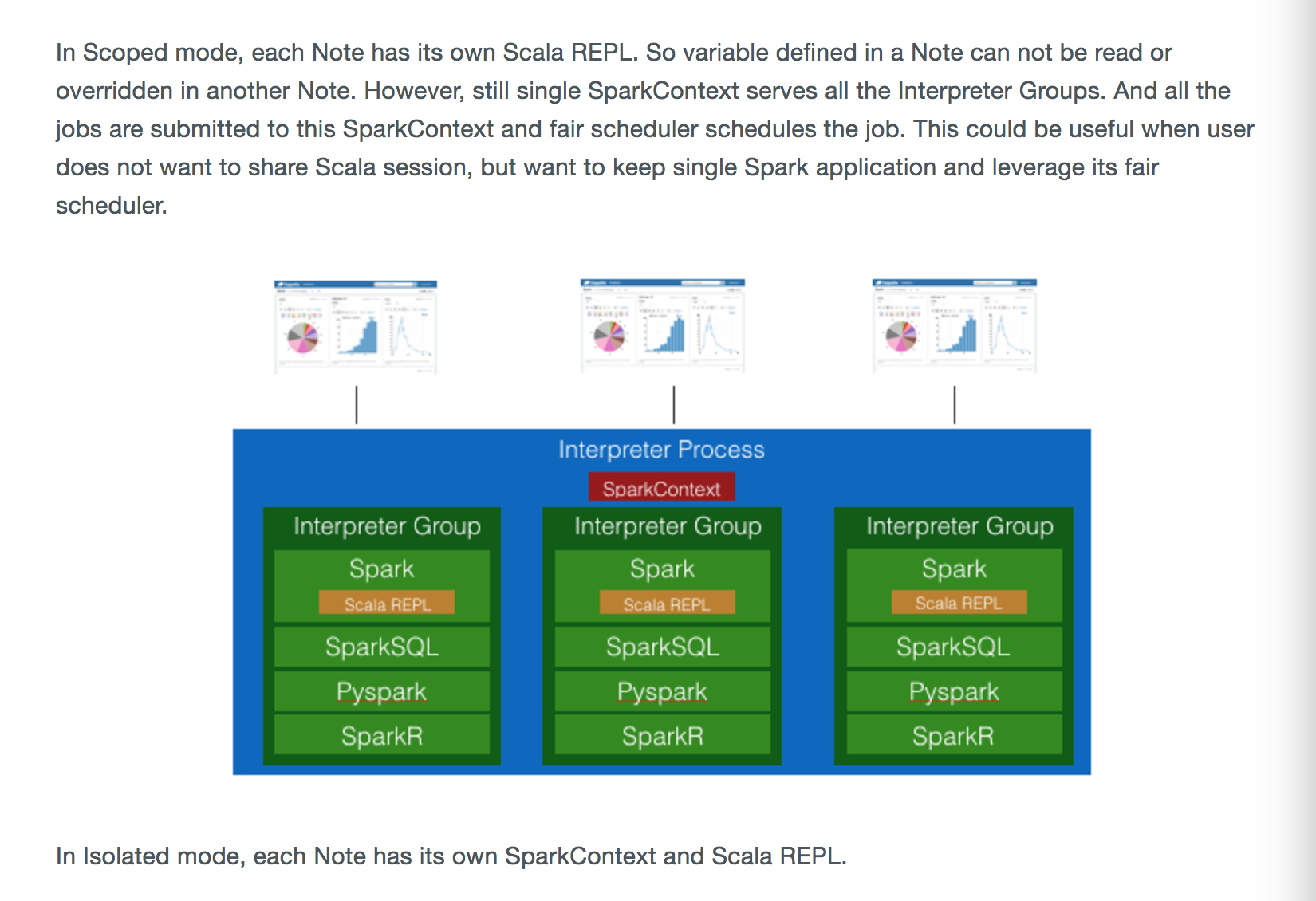  ### Questions: * Does the licenses files need update? - NO * Is there breaking changes for older versions? - NO * Does this needs documentation? - This PR is about docs. Author: 1ambda <1amb4a@gmail.com> Closes #2437 from 1ambda/ZEPPELIN-2582/docs-for-interpreter-modes and squashes the following commits:e0bcf26c[1ambda] fix: Docsa60fdbf2[1ambda] fix: Correct sentencescdeb7e8a[1ambda] docs: Update imgsd60c48ea[1ambda] fix: clarify descriptionc2317d92[1ambda] fix: Use basepath53411350[1ambda] docs: Remove multiple spark context boxes in scoped mode image07c4b02a[1ambda] fix: Provide more specific example for per user modee385ecf5[1ambda] docs: Use new imagesfc69bc60[1ambda] docs: Add UI images56f1a68b[1ambda] docs: Add description for per-user963f9ce7[1ambda] docs: Add column to explain sharing objects33b0736e[1ambda] fix: typo316c5634[1ambda] docs: Fix incorrect info for scoped mode, isolated mode729b56a2[1ambda] fix: Remove code perspectiveaf442263[1ambda] docs: Use lowercase for word note9ae9552a[1ambda] docs: emphasize per note mode in sopced, iolsated66d02ba7[1ambda] docs: Enhance description for ioslated mode83eb2e5f[1ambda] docs: enhance desc for scoped mode1eafb647[1ambda] docs: Add descroptoin for per user, per note43e8b023[1ambda] docs: Add summary table of @cacti77b43a4daf[1ambda] docs: Update interpreter binding mode page56836205[1ambda] feat: Add images






121 lines
6.1 KiB
Markdown
121 lines
6.1 KiB
Markdown
---
|
||
layout: page
|
||
title: "Interpreter Binding Mode"
|
||
description: ""
|
||
group: usage/interpreter
|
||
---
|
||
<!--
|
||
Licensed under the Apache License, Version 2.0 (the "License");
|
||
you may not use this file except in compliance with the License.
|
||
You may obtain a copy of the License at
|
||
|
||
http://www.apache.org/licenses/LICENSE-2.0
|
||
|
||
Unless required by applicable law or agreed to in writing, software
|
||
distributed under the License is distributed on an "AS IS" BASIS,
|
||
WITHOUT WARRANTIES OR CONDITIONS OF ANY KIND, either express or implied.
|
||
See the License for the specific language governing permissions and
|
||
limitations under the License.
|
||
-->
|
||
{% include JB/setup %}
|
||
|
||
# Interpreter Binding Mode
|
||
|
||
<div id="toc"></div>
|
||
|
||
## Overview
|
||
|
||
<center><img src="{{BASE_PATH}}/assets/themes/zeppelin/img/docs-img/interpreter_binding_per_note_user.png" height="70%" width="70%"></center>
|
||
<center><img src="{{BASE_PATH}}/assets/themes/zeppelin/img/docs-img/interpreter_binding_scoped_isolated.png" height="70%" width="70%"></center>
|
||
|
||
<br/>
|
||
|
||
Interpreter Process is a JVM process that communicates with Zeppelin daemon using thrift.
|
||
Each interpreter process has a single interpreter group, and this interpreter group can have one or more instances of an interpreter.
|
||
(See [here](../../development/writing_zeppelin_interpreter.html) to understand more about its internal structure.)
|
||
|
||
Zeppelin provides 3 different modes to run interpreter process: **shared**, **scoped** and **isolated**.
|
||
Also, the user can specify the scope of these modes: **per** user or **per note**.
|
||
These 3 modes give flexibility to fit Zeppelin into any type of use cases.
|
||
|
||
In this documentation, we mainly discuss the **per note** scope in combination with the **shared**, **scoped** and **isolated** modes.
|
||
|
||
## Shared Mode
|
||
|
||
<div class="text-center">
|
||
<img src="{{BASE_PATH}}/assets/themes/zeppelin/img/docs-img/interpreter_binding_mode-shared.png" height="40%" width="40%">
|
||
</div>
|
||
<br/>
|
||
|
||
In **Shared** mode, single JVM process and a single session serves all notes. As a result, `note A` can access variables (e.g python, scala, ..) directly created from other notes..
|
||
|
||
## Scoped Mode
|
||
|
||
<div class="text-center">
|
||
<img src="{{BASE_PATH}}/assets/themes/zeppelin/img/docs-img/interpreter_binding_mode-scoped.png">
|
||
</div>
|
||
<br/>
|
||
|
||
In **Scoped** mode, Zeppelin still runs a single interpreter JVM process but, in the case of per note scope, each note runs in its own dedicated session.
|
||
(Note it is still possible to share objects between these notes via [ResourcePool](../../interpreter/spark.html#object-exchange))
|
||
|
||
## Isolated Mode
|
||
|
||
<div class="text-center">
|
||
<img src="{{BASE_PATH}}/assets/themes/zeppelin/img/docs-img/interpreter_binding_mode-isolated.png">
|
||
</div>
|
||
<br/>
|
||
|
||
**Isolated** mode runs a separate interpreter process for each note in the case of **per note** scope.
|
||
So, each note has an absolutely isolated session. (But it is still possible to share objects via [ResourcePool](../../interpreter/spark.html#object-exchange))
|
||
|
||
## Which mode should I use?
|
||
|
||
<br/>
|
||
|
||
Mode | Each notebook... | Benefits | Disadvantages | Sharing objects
|
||
--- | --- | --- | --- | ---
|
||
**shared** | Shares a single session in a single interpreter process (JVM) | Low resource utilization and it's easy to share data between notebooks | All notebooks are affected if the interpreter process dies | Can share directly
|
||
**scoped** | Has its own session in the same interpreter process (JVM) | Less resource utilization than isolated mode | All notebooks are affected if the interpreter process dies | Can't share directly, but it's possible to share objects via [ResourcePool](../../interpreter/spark.html#object-exchange))
|
||
**isolated** | Has its own Interpreter Process | One notebook is not affected directly by other notebooks (**per note**) | Can't share data between notebooks easily (**per note**) | Can't share directly, but it's possible to share objects via [ResourcePool](../../interpreter/spark.html#object-exchange))
|
||
|
||
In the case of the **per user** scope (available in a multi-user environment), Zeppelin manages interpreter sessions on a per user basis rather than a per note basis. For example:
|
||
|
||
- In **scoped + per user** mode, `User A`'s notes **might** be affected by `User B`'s notes. (e.g JVM dies, ...) Because all notes are running on the same JVM
|
||
- On the other hand, **isolated + per user** mode, `User A`'s notes will not be affected by others' notes which running on separated JVMs
|
||
|
||
<br/>
|
||
|
||
Each Interpreter implementation may have different characteristics depending on the back end system that they integrate. And 3 interpreter modes can be used differently.
|
||
Let’s take a look how Spark Interpreter implementation uses these 3 interpreter modes with **per note** scope, as an example.
|
||
Spark Interpreter implementation includes 4 different interpreters in the group: Spark, SparkSQL, Pyspark and SparkR.
|
||
SparkInterpreter instance embeds Scala REPL for interactive Spark API execution.
|
||
|
||
<br/>
|
||
|
||
<div class="text-center">
|
||
<img src="{{BASE_PATH}}/assets/themes/zeppelin/img/docs-img/interpreter_binding_mode-example-spark-shared.png" height="40%" width="40%">
|
||
</div>
|
||
<br/>
|
||
|
||
In Shared mode, a SparkContext and a Scala REPL is being shared among all interpreters in the group.
|
||
So every note will be sharing single SparkContext and single Scala REPL.
|
||
In this mode, if `Note A` defines variable ‘a’ then `Note B` not only able to read variable ‘a’ but also able to override the variable.
|
||
|
||
<div class="text-center">
|
||
<img src="{{BASE_PATH}}/assets/themes/zeppelin/img/docs-img/interpreter_binding_mode-example-spark-scoped.png">
|
||
</div>
|
||
<br/>
|
||
|
||
In Scoped mode, each note has its own Scala REPL.
|
||
So variable defined in a note can not be read or overridden in another note.
|
||
However, a single SparkContext still serves all the sessions.
|
||
And all the jobs are submitted to this SparkContext and the fair scheduler schedules the jobs.
|
||
This could be useful when user does not want to share Scala session, but want to keep single Spark application and leverage its fair scheduler.
|
||
|
||
In Isolated mode, each note has its own SparkContext and Scala REPL.
|
||
|
||
<div class="text-center">
|
||
<img src="{{BASE_PATH}}/assets/themes/zeppelin/img/docs-img/interpreter_binding_mode-example-spark-isolated.png">
|
||
</div>
|
||
<br/>
|