mirror of
https://github.com/fleetdm/fleet
synced 2026-05-10 18:51:03 +00:00
 4a6bf0d447
Closes: https://github.com/fleetdm/confidential/issues/4015

Changes:
- Changed the url for `/fleetctl-preview` to
`/try-fleet/fleetctl-preview`
- Updated the controller for the `/fleetctl-preview` page to redirect
non-logged-in users to `/try-fleet/login`
- Removed the route for `/try-fleet/sandbox-expired`, and added a
redirect going to `/try-fleet/fleetctl-preview`.
- Updated the controller for `/try-fleet/sandbox` to redirect the users
without a non-expired Sandbox instance to `/try-fleet/fleetctl-preview`.
- Updated `signup.js` to not provision Fleet sandbox instances for
users.
- Updated the `User` model to support a third `signupReason`: "Try
Fleet"
- Updated `/try-fleet/register` to submit "Try Fleet" as a
`signupReason` when users sign up.
- Renamed the files for the `/fleetctl-preview` page (`get-started` »
`fleetctl-preview`)
- Updated/removed Fleet Sandbox related handbook sections.
- Replaced the "Fleet vs Fleet Sandbox" section in the deploying
documentation with a note about `fleetctl preview`.
- Updated links to Fleet Sandbox in articles.

---------

Co-authored-by: Mike Thomas <78363703+mike-j-thomas@users.noreply.github.com>
55 lines
4.2 KiB
Markdown
55 lines
4.2 KiB
Markdown
# Introduction
|
|
|
|
<!-- TODO: video -->
|
|
|
|
Fleet is the most widely used open source osquery manager in the world. Fleet enables programmable live queries, streaming logs, and realtime visibility of 100,000+ servers, containers, and laptops. It's especially useful for IT, security, and compliance use cases.
|
|
|
|
The Fleet application contains two single static binaries which provide web based administration, REST API, and CLI interface to Fleet.
|
|
|
|
The `fleet` binary contains:
|
|
- The Fleet TLS web server (no external webserver is required but it supports a proxy if desired)
|
|
- The Fleet web interface
|
|
- The Fleet application management [REST API](https://fleetdm.com/docs/using-fleet/rest-api)
|
|
- The Fleet osquery API endpoints
|
|
|
|
The `fleetctl` binary is the CLI interface which allows management of your deployment, scriptable live queries, and easy integration into your existing logging, alerting, reporting, and management infrastructure.
|
|
|
|
Both binaries are available for download from our [repo](https://github.com/fleetdm/fleet/releases).
|
|
|
|
> Note: You can try a preview environment of Fleet locally on your machine. [Get up and running in minutes](https://fleetdm.com/try-fleet/fleetctl-preview).
|
|
>
|
|
> If you want to enroll real hosts or deploy to a more scalable environment, we recommend [deploying Fleet to a server](https://fleetdm.com/docs/deploy/deploy-fleet-on-centos).
|
|
|
|
## Infrastructure dependencies
|
|
|
|
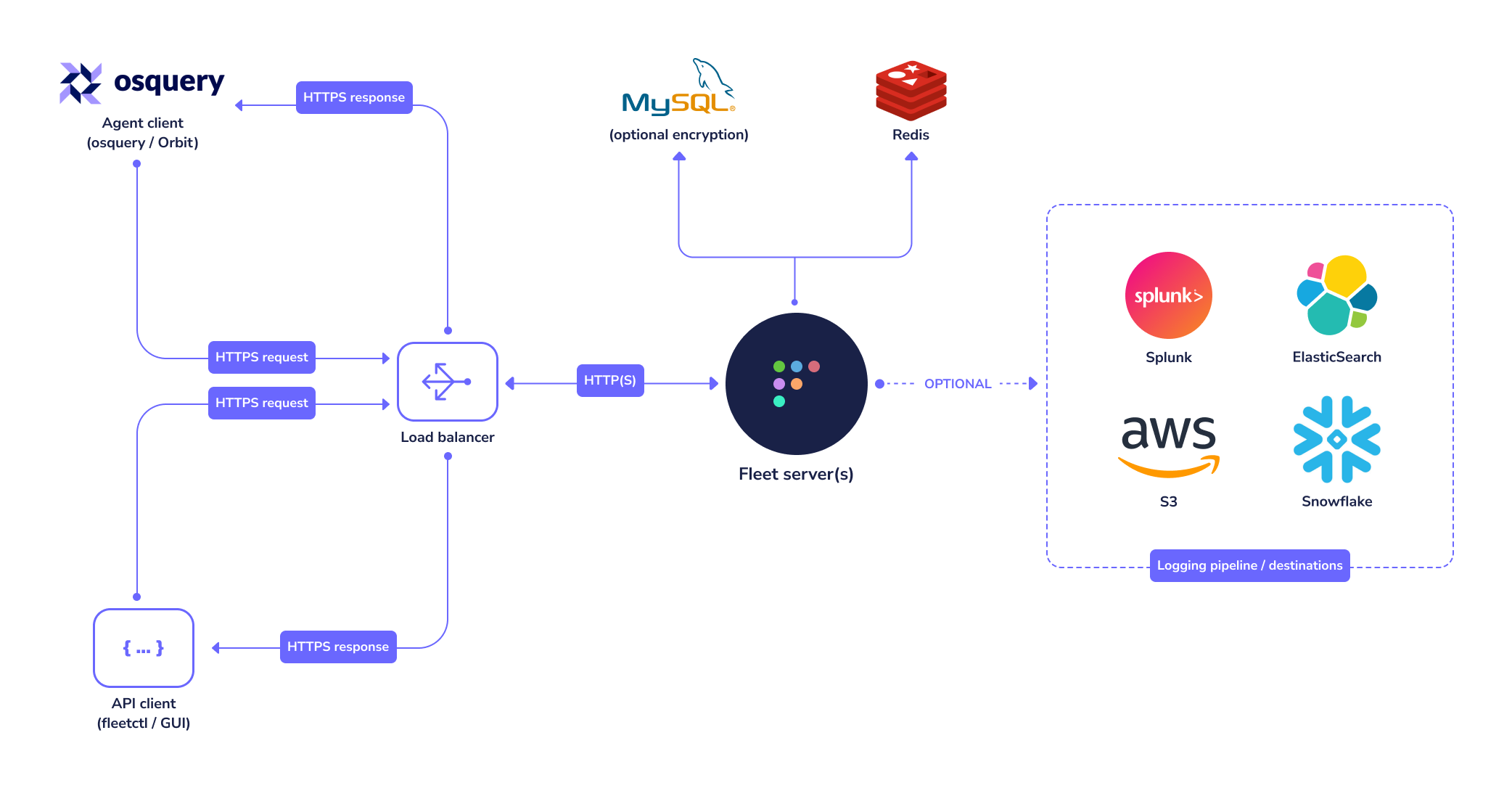
Fleet currently has three infrastructure dependencies: MySQL, Redis, and a TLS certificate.
|
|
|
|
|
|
|
|
### MySQL
|
|
|
|
Fleet uses MySQL extensively as its main database. Many cloud providers (such as [AWS](https://aws.amazon.com/rds/mysql/) and [GCP](https://cloud.google.com/sql/)) host reliable MySQL services which you may consider for this purpose. A well supported MySQL [Docker image](https://hub.docker.com/_/mysql/) also exists if you would rather run MySQL in a container. For more information on how to configure the `fleet` binary to use the correct MySQL instance, see the [Configuration](https://fleetdm.com/docs/deploying/configuration) document.
|
|
|
|
Fleet requires at least MySQL version 5.7.
|
|
|
|
### Redis
|
|
|
|
Fleet uses Redis to ingest and queue the results of distributed queries, cache data, etc. Many cloud providers (such as [AWS](https://aws.amazon.com/elasticache/) and [GCP](https://console.cloud.google.com/launcher/details/click-to-deploy-images/redis)) host reliable Redis services which you may consider for this purpose. A well supported Redis [Docker image](https://hub.docker.com/_/redis/) also exists if you would rather run Redis in a container. For more information on how to configure the `fleet` binary to use the correct Redis instance, see the [Configuration](https://fleetdm.com/docs/deploying/configuration) document.
|
|
|
|
## TLS certificate
|
|
|
|
In order for osqueryd clients to connect, the connection to Fleet must use TLS. The TLS connection may be terminated by Fleet itself, or by a proxy serving traffic to Fleet.
|
|
|
|
- The CNAME or one of the Subject Alternate Names (SANs) on the certificate must match the hostname that osquery clients use to connect to the server/proxy.
|
|
- If you intend to have your Fleet instance on a subdomain, your certificate can have a wildcard SAN. So `fleet.example.com` should match a SAN of `*.example.com`
|
|
- If self-signed certificates are used, the full certificate chain must be provided to osquery via the `--tls_server_certs` flag.
|
|
- If Fleet terminates TLS, consider using an ECDSA (rather than RSA) certificate, as RSA certificates have been associated with [performance problems in Fleet due to Go's standard library TLS implementation](https://github.com/fleetdm/fleet/issues/655).
|
|
|
|
## Community projects
|
|
|
|
Below are some projects created by Fleet community members. These projects provide additional solutions for deploying Fleet. Please submit a pull request if you'd like your project featured.
|
|
|
|
- [CptOfEvilMinions/FleetDM-Automation](https://github.com/CptOfEvilMinions/FleetDM-Automation) - Ansible and Docker code to set up Fleet
|
|
|
|
<meta name="pageOrderInSection" value="100">
|
|
<meta name="description" value="Learn about Fleet's architecture and infrastructure dependencies.">
|