
2.1 KiB
Git Webhook Configuration
Overview
ArgoCD will poll git repositories every three minutes for changes to the manifests. To eliminate this delay from polling, the API server can be configured to receive webhook events. ArgoCD supports git webhook notifications from GitHub, GitLab, and BitBucket. The following explains how to configure a git webhook for GitHub, but the same process should be applicable to other providers.
1. Create the webhook in the git provider
In your git provider, navigate to the settings page where webhooks can be configured. The payload URL configured in the git provider should use the /api/webhook endpoint of your ArgoCD instance (e.g. https://argocd.example.com/api/webhook). Input an arbitrary value in the secret. The same value will be used when configuring the webhook in step 2.
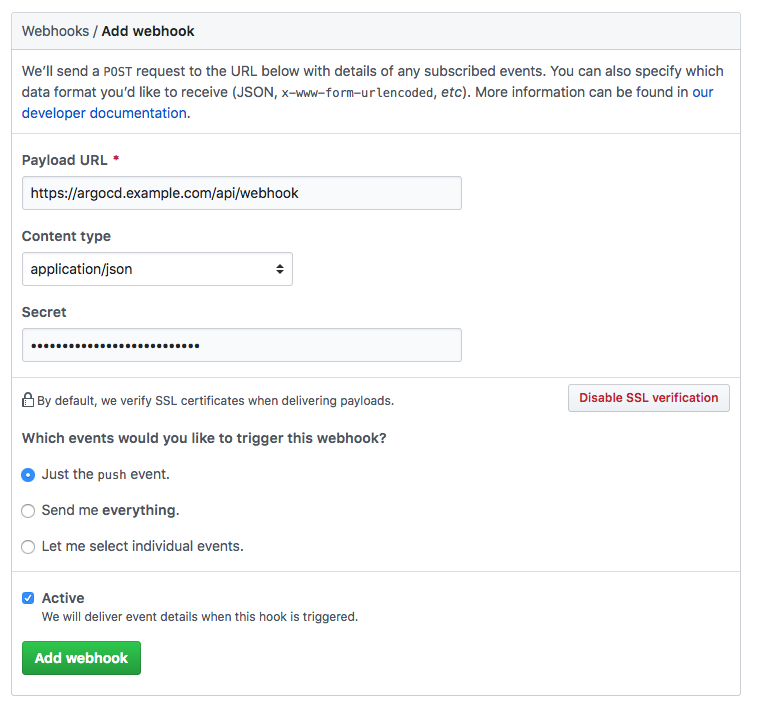
2. Configure ArgoCD with the webhook secret
In the argocd-secret kubernetes secret, configure one of the following keys with the git provider
webhook secret configured in step 1.
| Provider | K8s Secret Key |
|---|---|
| GitHub | github.webhook.secret |
| GitLab | gitlab.webhook.secret |
| BitBucket | bitbucket.webhook.uuid |
Edit the ArgoCD kubernetes secret:
kubectl edit secret argocd-secret
TIP: for ease of entering secrets, kubernetes supports inputting secrets in the stringData field,
which saves you the trouble of base64 encoding the values and copying it to the data field.
Simply copy the shared webhook secret created in step 1, to the corresponding
GitHub/GitLab/BitBucket key under the stringData field:
apiVersion: v1
kind: Secret
metadata:
  name: argocd-secret
  namespace: argocd
type: Opaque
data:
...

stringData:
  # github webhook secret
  github.webhook.secret: shhhh! it's a github secret

  # gitlab webhook secret
  gitlab.webhook.secret: shhhh! it's a gitlab secret

  # bitbucket webhook secret
  bitbucket.webhook.uuid: your-bitbucket-uuid
After saving, the changes should take affect automatically.